OTR 2
- 4.5
- Rating
- 1.00M
- Installs
- Free
- Price

 Analysis by App-foxy
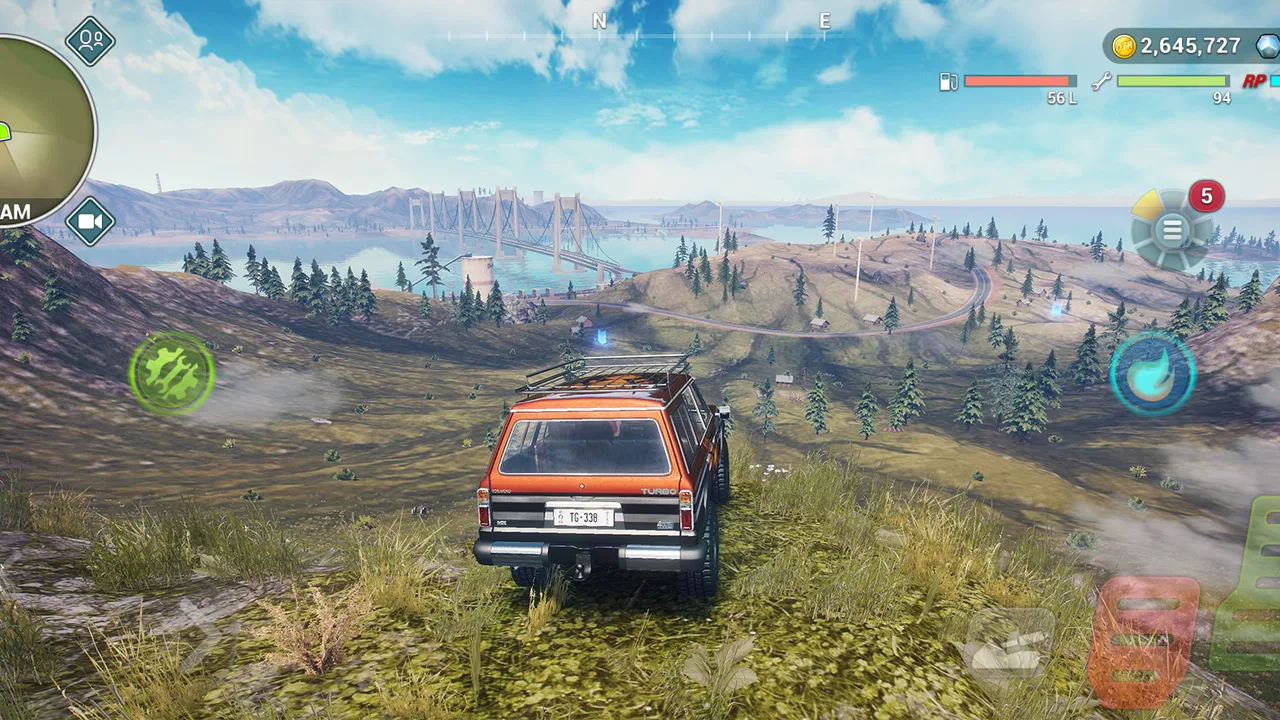
I approached OTR 2 as the kind of racing game you open when you want more than a short burst around a fixed circuit. It comes from DogByte Games, sits in the racing category, and focuses its appeal on open-road driving with an off-road flavor. That difference matters: this is not simply about memorizing corners and chasing a perfect lap. The attraction is the feeling of choosing a direction, dealing with rough terrain, and making the drive itself the main event.
My first impression is that the game is aimed at players who enjoy the slower, more deliberate side of vehicle games as much as the excitement of racing. The truck-simulator angle gives it a broader identity than a conventional arcade racer, while the off-road setting suggests that getting from one place to another can be just as interesting as finishing first. If you like exploring driving environments, testing how a vehicle handles difficult ground, and returning to improve your approach, this is a much more natural fit than a game built only around quick races.
How to decide whether OTR 2 fits your driving style
The most useful question is not whether you already play racing games. It is what you expect from one. If your ideal session lasts a few minutes and gives you immediate speed, a traditional arcade racer may serve you better. If you want a vehicle game that leaves room for exploration and lets the landscape influence your choices, OTR 2 deserves a closer look.
You May Also Like

 Blood Strike: 2.5 Anniversary
Blood Strike’s Loadouts Turn Every Drop Into a Tactical Gamble
A close look at Blood Strike’s custom loadouts: how fast access to signature weapons reshapes its battle royale rhythm, rewards preparation, and narrows the gap between fights.

 Pandora - Music & Podcasts
Pandora’s Music Is Easy to Start, but Harder to Recover
Pandora’s strength is its low-effort path from a seed to a station. Its weak spot is how much confidence it asks you to place in connection, setup, and quiet recovery.

 8 Ball Pool
 Is Built on Rivalries, Rematches, and Routine
A close look at the rivalries, rematches, shared routines, and unanswered safety questions that turn a quick pool match into a persistent mobile community.

 Samsung Music
’s Quiet Strength Is Playing What You Already Own
Its reach comes less from spectacle than from dependable access to a personal library. That simplicity is both the app’s strongest retention engine and its ceiling.

 AccuWeather: Weather Radar
AccuWeather Review: A Quick, Clear Forecast for Everyday Decisions
For everyday plans, the best forecast is the one you can understand quickly. AccuWeather makes rain timing, radar, and local conditions easy to act on, with a few trade-offs.

 Hill Climb Racing
Why Hill Climb Racing Still Turns Crashes Into One More Run
A tiny car, a bumpy hill and one more upgrade: Hill Climb Racing keeps resurfacing because its simple chaos makes every near-miss feel personal.
More From Our News Desk
View All News


I would judge it using four practical criteria. First, consider whether open-world driving sounds more appealing than a sequence of enclosed tracks. Second, ask how much patience you have for off-road movement, where progress can feel less predictable than on smooth pavement. Third, think about whether you enjoy a game that can be played casually but also rewards learning the environment. Finally, decide how comfortable you are with a free game that includes optional purchases ranging from $0.99 to $49.99 per item.
That last point is worth considering before you begin. The game is free to install, so there is no entry fee standing between you and a first session. The purchase range means that spending can become part of the experience for players who want optional extras, but I would still approach it with a personal limit in mind. A free download is easiest to enjoy when you decide in advance whether you are treating it as a no-spend game or as a title where occasional purchases are acceptable.
The age rating is Everyone, which makes the game easier to recommend in households where a broadly accessible driving title is preferred. That does not automatically mean every player will enjoy it. Younger players may need help understanding progression or purchase decisions, while experienced racing fans may find the pace less immediately thrilling than a dedicated speed-focused game.
What the open-road format changes
In a normal circuit racer, the track tells you what to do: brake here, turn there, and repeat the route until your time improves. OTR 2 has a different rhythm. Its open-world framing makes the route itself part of the decision. I find that more engaging when I am in the mood to drive rather than compete constantly, because the game can turn a simple trip into a small problem-solving exercise.
A useful way to play is to treat each outing as a test rather than a race. Instead of rushing toward the most obvious destination, I would first learn how the terrain affects the vehicle. Notice which approaches feel manageable, where momentum helps, and when a safer line is better than a direct one. This habit gives the driving more depth without requiring the game to become complicated.
That also reveals one of the title’s less obvious strengths: it can work as a short relaxation game even when you are not chasing a major objective. A realistic everyday scenario would be opening it during a commute break or after work, taking one purposeful drive, and stopping once you have completed a small personal goal. The open environment makes that session feel less repetitive than replaying the same compact track, provided you enjoy gradual progress rather than instant spectacle.
Why the truck-simulator identity matters
Many racing games make the vehicle feel like a tool for speed. OTR 2 leans toward making the vehicle feel like the center of the experience. That changes what I pay attention to. I am not only watching the road; I am thinking about how the vehicle behaves when the surface becomes difficult and whether my chosen route suits the kind of driving I want to do.
This is where the game can appeal to players who normally skip racing titles. Someone who enjoys driving simulators, exploration games, or off-road challenges may find a more natural entry point here than in a game dominated by supercars and polished circuits. The emphasis is less about presenting a perfect racing line and more about making the journey feel like a physical task.
My advice is to avoid judging the game during the first few minutes by asking whether it is fast enough. The better test is whether you enjoy the decisions between points of interest: which direction to take, how aggressively to approach rough ground, and whether a direct route is genuinely the best one. If those choices interest you, the game’s format is doing its job.
Where this game wins against familiar racing alternatives
OTR 2 has a clear advantage over standard track racers for players who become bored by repetition. A fixed circuit can be satisfying when you want precision, but it also narrows every session to the same sequence of turns. An open driving environment gives me more freedom to create my own objective. I can focus on reaching a destination, practicing control, exploring a route, or simply enjoying the vehicle.
It also offers a stronger sense of place than a menu of disconnected races can provide. Even without inventing specific systems or missions, the open-world structure changes the emotional tone. The drive feels like an outing, not just an attempt to beat a clock. That makes the game particularly suitable for players who want racing elements without the pressure of constant competition.
Compared with a pure truck simulator, the racing category gives OTR 2 a more approachable starting point. You do not need to arrive looking for a highly specialized simulation to appreciate the appeal. The game can be enjoyed as an off-road driving experience first, with the simulator framing adding weight to your choices. For me, that balance is more inviting than a title that demands total commitment to realism from the beginning.
Another strength is its flexibility of mood. I can imagine playing it actively, trying to improve my handling and route choices, or using it as a low-pressure driving game. That range is valuable on mobile because the same title can suit different moments. A short session can still feel worthwhile, while a longer one has room for exploration and experimentation.
The public response also suggests that the game has found an audience. It holds an average rating of 4.5 from around 11 thousand ratings, with over 500 thousand installs. I would not treat those figures as a guarantee that it will match your taste, but they do make the game easier to approach with confidence than an unknown release that has attracted little attention.
Three practical habits that improve the experience
My first tip is to separate exploration from performance. On an early drive, do not try to be fast and learn every route at the same time. Pick one objective and pay attention to how the environment responds. Once you understand the area, repeat the trip with a more deliberate line. This reduces frustration and gives you a clearer sense of whether your improvement comes from better control or simply from knowing where to go.
Second, use the open world to create small challenges that the game may not explicitly place in front of you. You might choose a destination and attempt to reach it without taking the most obvious approach, or compare a careful route with a direct one. These self-made goals are especially useful when you have only a few minutes because they give the session a clear beginning and ending.
Third, resist the urge to spend immediately. Since the game is free and includes in-app purchases, I would play enough to decide whether the driving itself is enjoyable before considering anything optional. This is not just a money-saving suggestion. It also prevents purchases from disguising a mismatch between your preferred style and the game’s slower, terrain-focused rhythm.
A fourth habit is to adjust your expectations when switching from a circuit racer. Do not carry over the assumption that every successful move must be the fastest possible move. In off-road driving, control and route selection can matter more than raw speed. That mindset makes the game feel more coherent and helps explain why a cautious approach can be satisfying rather than boring.
Where another type of game may suit you better
OTR 2 is not the right choice for everyone. If your priority is immediate acceleration, dramatic overtakes, and short competitive events, a conventional arcade racer will probably feel more rewarding. Those games are designed to deliver excitement quickly, while this title asks you to appreciate the space between major moments.
Players who want strict simulation may also prefer a more specialized driving game. The truck-simulator label gives OTR 2 a grounded identity, but the open-world racing format makes it more approachable than a dedicated professional-style simulator. If you are looking for detailed procedures, tightly controlled logistics, or a highly technical recreation of commercial driving, you should compare those expectations carefully before committing your time.
There is also a trade-off for people who dislike unstructured play. Open environments offer freedom, but freedom can feel vague when you want the game to tell you exactly what to do next. I enjoy making my own short-term goals, yet I understand why another player might prefer a clear event list and a visible finish line. In that situation, a track-based alternative may provide a cleaner sense of progress.
The free-to-play model is another possible point of friction. The download price is free, which lowers the risk of trying it, but the purchase range can make some players cautious. If you prefer a single upfront payment and no temptation to buy anything during play, a paid racing game may be a better psychological fit even if its initial cost is higher.
Device compatibility is relatively broad: the game requires Android 6.0 or later. That makes it accessible to many Android users, although compatibility on paper is not the same as identical performance on every phone. If your device is older or has limited space and memory, I would begin with modest expectations and close other demanding apps before playing. The current version is 1.0.2, so keeping the installation updated is sensible when you want the intended current experience.
The real cost of switching from another racer
Switching to OTR 2 costs more than downloading a different game because it asks you to change your definition of progress. In a lap racer, improvement is easy to measure through time, position, or a cleaner run. Here, progress can come from understanding the environment and becoming more confident with the vehicle. That is rewarding, but it takes a little adjustment.
You may also need to give up the instant clarity of a race-start screen. Instead of being told that every session is about finishing first, you have to decide what a successful drive means. I see that as the main learning curve, not a complicated control scheme. Once you accept it, the game becomes easier to evaluate on its own terms.
For someone coming from a truck simulator, the transition may be the opposite. You gain a more accessible racing identity, but you may lose some of the satisfaction that comes from extremely formal driving routines. For someone coming from an arcade racer, you gain exploration and terrain-based decision-making, but you sacrifice some immediate intensity. The best alternative depends on which of those trade-offs you are actually trying to make.
One practical way to switch without wasting time is to give the game a focused trial. Play several sessions with different intentions: one for simple exploration, one for careful vehicle control, and one where you set a personal route goal. If none of those approaches feels enjoyable, the problem is probably not that you have failed to understand the game. It is likely that you prefer a more direct racing structure.
My recommendation for different kinds of players
I recommend OTR 2 to players who want an open-world racing game with a clear off-road and truck-driving identity. It is especially appealing if you like making your own objectives, learning routes, and treating the drive as an experience rather than a nonstop contest. The free entry point makes it easy to test, and the Everyone rating makes it a broadly approachable option for casual family gaming, with sensible supervision around purchases.
I would also recommend it to someone who says, “I like driving games, but I am tired of repeating the same track.” The open format gives that player a different kind of variety. It does not depend on inventing a new rival or a new circuit every few minutes; instead, it makes the environment and the chosen route more important.
I would not recommend it as the first choice for a player who wants pure speed, tightly structured races, or a serious, highly technical truck simulation. In those cases, a focused arcade racer or a dedicated simulator may deliver a more precise match. Choosing another category would not mean OTR 2 is weak; it would simply mean that its central appeal is not what you are looking for.
My final view is positive, with one important condition: you need to enjoy the journey. DogByte Games has positioned this as a driving game where open terrain and off-road fun matter as much as racing. That gives it a distinctive place between arcade competition and truck simulation. I would install it for the freedom to explore, keep my spending controlled, and judge it by the quality of its driving decisions rather than by how quickly it reaches the next race.
For me, the strongest reason to try it is the freedom to turn each drive into your own small challenge. That is also the reason some players should skip it. If you want the game to provide all the urgency, structure, and competition, choose a more traditional racer. If you enjoy taking the wheel, reading the terrain, and deciding what makes a session worthwhile, OTR 2 is a convincing free option to put on your shortlist.
FAQs for OTR 2
01What is OTR 2, and what are its main features?
OTR 2, or Off The Road 2, is an open-world driving simulator that offers a realistic off-road experience. It features stunning graphics, a variety of vehicles including trucks, boats, and helicopters, and dynamic weather systems. Players can explore expansive landscapes, complete challenges, and customize their vehicles to enhance their off-roading adventure.
02Is OTR 2 available for both Android and iOS devices?
Yes, OTR 2 is available for download on both Android and iOS platforms. You can find it on the Google Play Store for Android users and the Apple App Store for iOS users. Ensure your device meets the app’s minimum requirements for optimal performance and gameplay experience.
03Does OTR 2 require an internet connection to play?
OTR 2 primarily offers offline gameplay, allowing you to enjoy the game without an active internet connection. However, certain features like online leaderboards or multiplayer modes might require internet access. It’s advisable to periodically connect to the internet to receive updates and new content.
04Are there in-app purchases in OTR 2, and how do they affect gameplay?
OTR 2 includes in-app purchases that allow players to buy currency for vehicle upgrades, unlock new vehicles, or customize their rides. While these purchases can enhance the gaming experience, they are optional, and the game can be fully enjoyed without spending money. Progression is possible through completing challenges and earning rewards.
05What are the system requirements for installing OTR 2 on my device?
For Android devices, OTR 2 requires at least Android version 5.0 and a minimum of 2GB RAM for smooth performance. For iOS devices, it requires iOS 10.0 or later. A device with a decent processor and graphics capabilities will ensure the best experience. Be sure to have sufficient storage space for additional content and updates.
Pros
- Intuitive user interface for easy navigation.
- High-quality audio and video streaming.
- Secure and private communication features.
- Wide range of customization options.
- Lightweight and fast performance.
Cons
- Limited offline functionality.
- Occasional connectivity issues.
- In-app purchases can be pricey.
- Some features require a subscription.
- Limited support for older devices.

OTR 2
Gallery